
Bedtime Routines
The Perfect Toddler Bedtime Routine (Step-by-Step Guide + Free Printable Chart)
A research-backed guide to building a calm 20–30 minute toddler bedtime routine, with a free printable chart you can stick on the fridge.
Every parent knows the scene: it's 7:45 p.m., you announce bedtime, and suddenly your toddler needs water, another hug, one more book, and to tell you something very important about a dog they saw three days ago. Sound familiar?
The good news: a consistent bedtime routine can transform these nightly battles into a calm, predictable wind-down that helps your toddler fall asleep faster — and helps you reclaim your evening. Below, we'll walk through exactly how to build one, step by step, plus a free printable bedtime routine chart you can stick on the fridge.
Why a Consistent Bedtime Routine Matters
Pediatric sleep researchers have studied bedtime routines extensively, and the evidence is clear: children with consistent nightly routines fall asleep more easily and sleep longer.
A landmark study published in Sleep found that a consistent bedtime routine was associated with better sleep outcomes in young children, with the benefits increasing the more consistently the routine was followed (Mindell et al., 2015, Sleep, 38(5), 717–722). The American Academy of Pediatrics (AAP) recommends establishing a regular bedtime routine as part of healthy sleep hygiene for children.
A later review in Sleep Medicine Reviews found that bedtime routines in young children were associated not only with improved sleep but also with broader developmental benefits including language development, literacy, and child emotional and behavioral regulation (Mindell & Williamson, 2018, Sleep Medicine Reviews, 40, 93–108).
What does this mean for you? A bedtime routine isn't just a nice-to-have — it's one of the most evidence-backed tools parents have for improving their toddler's sleep. And the best part: it doesn't need to be complicated.
Note: Every child is different. The tips in this guide are based on published research and pediatric recommendations, but they are not medical advice. If your child has persistent sleep difficulties, consult your pediatrician.
The Ideal Toddler Bedtime Routine: 5 Steps in 30 Minutes
The sweet spot for a toddler bedtime routine is 3–5 steps over 20–30 minutes. Shorter than that and your toddler may not have enough time to wind down; much longer and you risk stalling and power struggles.
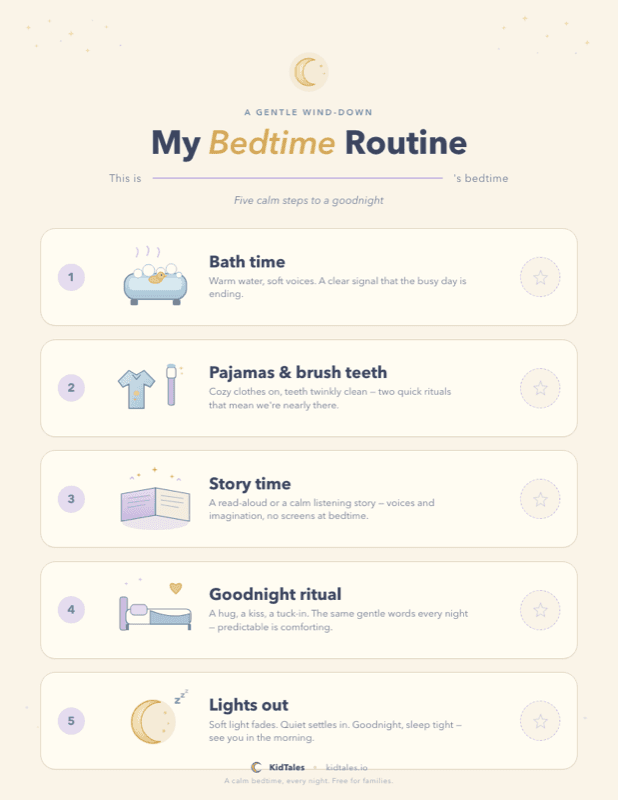
Here's a research-backed sequence that works for most toddlers aged 18 months to 4 years:
Step 1: Bath Time (5–10 minutes)
A warm bath isn't just about getting clean — it's a powerful physiological signal. The slight rise and then drop in body temperature after a bath mimics what happens naturally as we fall asleep, helping trigger drowsiness.
Tips:
- Keep the water warm, not hot
- Use calming scents like lavender if your child tolerates them (no essential oils for children under 2 without pediatric guidance)
- If you're skipping the bath on a given night, a warm washcloth face-and-hands wipe can serve the same transitional purpose
Step 2: Pajamas & Brush Teeth (5 minutes)
This is the "getting ready" step. It's practical, but it also signals that the active part of the day is over.
Tips:
- Let your toddler pick between two pajama options — giving a small choice reduces power struggles
- Use a 2-minute song or timer for tooth brushing to keep it consistent
- Keep the lighting dim if possible; bright bathroom lights can suppress melatonin production
Step 3: Quiet Activity — Story, Song, or Audio Story (10 minutes)
This is the heart of the routine and where you create connection. Options include:
- Read a picture book together — 1 to 2 short books is the sweet spot. More than that invites "one more!" negotiations
- Listen to a short audio story — Audio stories work especially well for toddlers who get visually stimulated by picture books at bedtime. A calm, narrated story lets them close their eyes and start drifting. Apps like KidTales offer personalized audio stories designed specifically for wind-down time
- Sing a lullaby or quiet song — Repetition is your friend. The same song every night becomes a sleep cue
Looking for more wind-down options? See our roundup of 14 screen-free activities for kids — the "Bedtime Wind-Down" section covers calming alternatives if books and audio stories aren't landing tonight.
Pro tip: Set a clear expectation: "We'll read two books tonight" or "We'll listen to one story." This prevents the endless "one more" loop.
Step 4: Goodnight Ritual (2–3 minutes)
A short, repeatable ritual signals "this is the end." Examples:
- Say goodnight to three favorite stuffed animals or objects in the room
- Do a "goodnight hug and three kisses" sequence
- Use a simple phrase: "I love you, sleep tight, see you in the morning"
The key is consistency. The same words, the same order, every night. Your toddler's brain learns to associate this sequence with falling asleep.
Step 5: Lights Out & Exit (1–2 minutes)
Turn off the main light (a dim nightlight is fine), say your final goodnight, and leave the room.
Tips:
- If your toddler protests, keep your response brief and boring: "It's sleep time. I love you. Goodnight."
- Avoid re-engaging with new conversation — this teaches your child that protesting extends the interaction
- A white noise machine or soft background sound can help mask household noises
Free Printable Toddler Bedtime Routine Chart
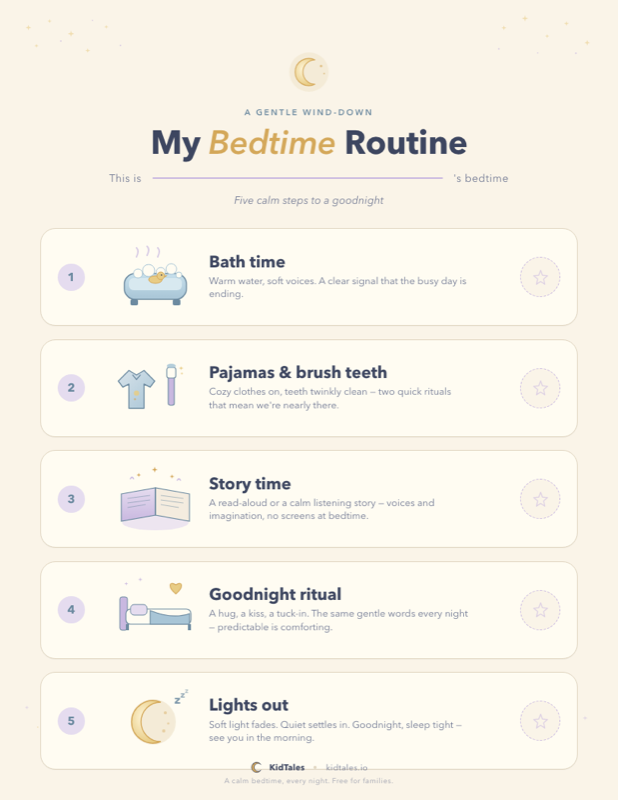
We've created a simple, visual bedtime routine chart you can download and print. It shows each step of the routine with gentle illustrations your toddler can follow along with.
Why use a visual chart?
- Toddlers can't tell time, but they can follow a sequence of pictures
- It shifts the authority from "mom/dad says it's time to brush teeth" to "the chart says brush teeth is next"
- It gives your toddler a sense of control and predictability
Grab the printable below — drop your email and we'll send you a download link (Letter by default; an A4 version is offered too for parents outside the US).
How to use it once you've printed it:
- Print and laminate it (or slip it into a plastic sleeve)
- Hang it at your toddler's eye level — bathroom door, bedroom wall, or fridge
- Walk through the chart together for the first few nights: "Look, first we do bath, then pajamas..."
- Optional: add a sticker or checkmark system so your toddler can "complete" each step
Troubleshooting: When the Routine Breaks Down
Even the best routine will hit bumps. Here's how to handle the most common ones:
"I'm not tired!"
Try: Move bedtime 15–20 minutes later temporarily, then gradually shift it earlier by 5 minutes every few days. A toddler who isn't tired at 7:00 p.m. may settle easily at 7:30. Also check that daytime naps aren't running too late — most toddlers do best when the nap ends by 3:00 p.m.
"One more book! One more story!"
Try: Set the expectation at the start: "Tonight we'll read two books." Use a visual cue — hold up two fingers, or let them pick two books from a pre-selected set. When it's done, the chart says it's time for the next step, not you.
"I need water / I have to go potty / I'm scared"
Try: Build one "last chance" into the routine: a sip of water and a potty trip right before the goodnight ritual. For fears, validate briefly ("I understand, and you're safe") without launching into a long discussion. A nightlight and a "brave buddy" stuffed animal can help.
The routine is taking 45+ minutes
Try: Audit each step. The most common culprits are too many books, long negotiations about pajama choices, or a parent who sits with the child until they fall asleep. Aim for 20–30 minutes total. If your child is used to a longer routine, shorten it gradually — drop 5 minutes per week.
Routine falls apart on vacation or at grandparents' house
Try: Bring the printable chart with you. Even if the setting changes, the sequence stays the same. Pack familiar items (same pajamas, same stuffed animal, the same audio story app on your phone). Consistency in the routine compensates for inconsistency in the environment.
FAQ
What time should my toddler go to bed?
Most toddlers (18 months to 3 years) do well with a bedtime between 7:00 and 8:00 p.m., depending on wake time and nap schedule. The AAP doesn't prescribe a specific bedtime but recommends that toddlers get 11–14 hours of total sleep per 24 hours (including naps).
How long should the bedtime routine take?
20–30 minutes is the sweet spot. Shorter routines may not give your toddler enough wind-down time. Routines longer than 30 minutes tend to invite stalling.
At what age should I start a bedtime routine?
You can start simple bedtime cues as early as 3–4 months. By 12–18 months, most children benefit from a structured multi-step routine. It's never too late to start — even a 4-year-old with no established routine will respond within 1–2 weeks of consistency.
Does every night have to be exactly the same?
The order and core steps should stay consistent. But you can flex within a step — different book choices, different songs, different story on the app. The structure is what matters, not rigid sameness.
What if my partner does bedtime differently?
This is common. The goal isn't identical behavior from every caregiver, but the same sequence of steps. If Dad reads books and Mom does audio stories for the "quiet activity" step, that's fine — the routine chart stays the same.
My toddler shares a room with a sibling. How do I handle bedtime?
Stagger bedtimes by 15–20 minutes if possible (younger child first). Use the same chart for both children so they each "own" their routine. Quiet activities work better than loud ones in shared rooms — this is where audio stories with a small speaker really shine.
Make It Stick: Your First Week
Night 1–2: Introduce the chart. Walk through each step together. Expect it to take longer than 30 minutes — that's normal.
Night 3–4: Your toddler starts anticipating the next step. Resist the urge to add steps or extend the routine. Keep it tight.
Night 5–7: The routine starts to feel automatic. If bedtime battles have decreased noticeably, you're on track. If not, check the troubleshooting section above.
After 2 weeks: The routine is established. Your toddler may even remind you of the next step. This is the goal — when the routine runs itself, bedtime becomes the easiest part of the day.
Sources:
- Mindell, J.A., Li, A.M., Sadeh, A., Kwon, R., & Goh, D.Y.T. (2015). Bedtime routines for young children: A dose-dependent association with sleep outcomes. Sleep, 38(5), 717–722.
- Mindell, J.A., & Williamson, A.A. (2018). Benefits of a bedtime routine in young children: Sleep, development, and beyond. Sleep Medicine Reviews, 40, 93–108.
- American Academy of Pediatrics. (2016). AASM Pediatric Sleep Duration Consensus Statement. Endorsed by the AAP.
Try KidTales tonight
A bedtime story made for your kid.
Pick a character, choose a theme, and we’ll generate a calming, age-appropriate audio story ready to play before lights out.